Shares
Learn who can become a shareholder and how to invest. Find recent announcements and important dates relating to our shares.


LaS and DaS were launched in 2025. Eligible growers and shareholders can receive their June Loyalty payment as Zespri shares rather than cash (LaS), while eligible shareholders can reinvest all or part of their July dividend payment into Zespri shares (DaS). Together, they provide a third pathway for purchasing Zespri shares alongside on-market and off-market trading.
LaS and DaS were developed as part of the Shareholder Alignment project with the aim of increasing the number of growers who own Zespri shares. You can read more about this project on the Share Alignment page.
The Loyalty as Shares (LaS) and Dividends as Shares (DaS) have closed for 2026. Shares for this year's LaS and DaS offer were issued to LaS participants on 13 July and to DaS participants on 17 July 2026.
Since the introduction of Loyalty as Shares and Dividends as Shares in 2025 we have seen encouraging progress towards our share ownership target of 80 percent grower ownership by 2035. More information on this years results from 2026 Las and DaS can be viewed below.
There were two updates to the terms of LaS and DaS for 2026
The Board has approved the strike price for 2026 to be $7.65. The Board were supported in establishing the strike price by an independent valuation from leading investment bank Northington Partners.
To help growers make an informed decision on whether to buy Zespri Group Limited shares, a Product Disclosure Statement (PDS) is available for growers to view here or on the Companies Office website here by searching for offer number OFR13848. We also recommend you seek professional advice.
Below, you can find all the resources created to help guide you through the LaS & DaS process.
The Board decided not to proceed with a buy-back in 2026. While a buy-back can provide a tax-efficient way to return excess capital to shareholders and help reduce dilution from the 2026 LaS and DaS share issues, the Board considered an already tight trading market, acknowledging that a buy-back this year would reduce the number of shares available for sale (shares that could otherwise be bought by other growers rather than bought by Zespri and cancelled), while also likely attracting low shareholder take-up based on numbers from the 2025 buy-back.
Further, with no current Class B share overhang, there is currently less need to provide this type of exit option. Any surplus capital available for distribution will be assessed once the 2026 share issues are finalised in mid-July and is likely to be returned to shareholders via a taxable special dividend later this year.
Analysis of the 2025 offers showed that 51 percent of LaS participants were new to owning Zespri shares, resulting in the biggest increase in ownership in many years. At the same time, a large amount of the new shares issued under LaS and DaS went to shareholders above 2:1. A 1:1 threshold keeps the support focused where it is most needed to growers building their first shareholding or closing an alignment gap.
Restricting LaS and DaS still provides benefit to existing shareholders because share issues may raise surplus capital and can dilute non-participating shareholders’ ownership levels in Zespri. Restricting the number of eligible growers will help to manage the number of new shares being issued and excess capital raised. From a broader perspective, it also helps foster a united, stable industry that can come together to make value-creating decisions that will benefit growers and shareholders in the longer term.
Zespri will communicate with eligible growers ahead of the offer period to help you understand your personal situation and eligibility. Growers can get support via:
If you have any questions about your individual situation and would like to speak to one of the Investor Relations Team please contact us, via email at shares@zespri.com or call us on 07 572 6402.
- If you are an existing shareholder you will receive an annual shareholder measurement statement in mid-April. This will have the last completed season’s production included which is used to calculate your orchard’s average production. You can use the average production figure to help work out your 1:1 share ratio.
Example 1: If your average production total is 151,994 and your current shareholding is 42,428 then you are at a 0.28 share ratio and are currently under the 1:1 ratio. Number of shares (42,428) ÷ Average production (151,994) = 0.28 or 0.28:1
Example 2: If your average production total is 151,994 and your current shareholding is 250,454 then you are at a 1.65:1 share ratio and are currently over the 1:1 ratio.
Eligibility criteria will be reviewed annually and communicated in advance of the offer period each year.
In 2025, more than half of LaS participants were brand new shareholders. Narrowing eligibility keeps this momentum going and avoids situations where already aligned or over-aligned growers absorb a large portion of shares.
At the end of the offer period, Zespri will opt-out any growers who are over the 1:1 threshold and notify those growers.
Imputation credits allow shareholders to benefit from the income tax that Zespri has already paid. This means Zespri’s profits are not taxed twice when paid to the shareholder. A shareholder can use the imputation credit to reduce the income tax they have to pay on dividends they have received from Zespri. Computershare calculate the tax payable on the dividend payment and withhold this for payment direct to the IRD. The amount of tax withheld will be shown on your dividend statement which is sent by Computershare on payment date.
Will existing shareholdings be ‘diluted’ if new shares are issued in lieu of loyalty payments or dividends?
Dilution refers to the reduction of ownership percentage of existing shareholders in a company when new shares are issued by the company. As new shares are being issued as part of the LaS and Das initiatives, the ownership percentage of existing shareholders (who do not opt-in to LaS or DaS initiatives) will be reduced. A reduction in ownership percentage may result in:
Any new shares issued will be issued at a price that the Zespri Board has determined to be fair and reasonable to Zespri and all shareholders, and will be supported by an independent valuation. At the time of issue, as the new capital funding is at a fair price and results in higher Zespri cash holdings, the value of all shares should not be impacted.
Dilution of share value would occur if the new shares were given away or exchanged for less than fair value. In those circumstance the value of the company is being “split" more ways with no incoming funds or less than fair value incoming funds. That’s not happening under these initiatives. Growers who opt-in are purchasing their new shares with their loyalty funds or dividends. The new shares are not gifted, the issue of shares is an injection of new capital into Zespri.
How are these initiatives good for existing shareholders?
The intention of LaS and DaS is to increase the number of growers who own Zespri shares. This helps to align the commercial incentives of growers so we’re better placed to make the right commercial decisions to create value for growers. More growers owning shares in Zespri, and benefitting from both fruit returns and the performance of the corporate and with more control over the future of the industry, is critical to our ability to make positive commercial decisions, to create ongoing value and to respond to challenges. It will help us to build a more resilient business and to ensure the Single Desk continues to work well for growers.
Shares are issued by Zespri Group Limited.
Do these shares carry equal voting rights with other Zespri shares?
Yes. Shares issued under the LaS and DaS initiatives will carry equal voting rights with other Zespri ordinary shares and will have the rights (including voting rights) prescribed under Zespri’s constitution. Note that Zespri’s constitution qualifies normal voting rights. For a summary of the key features of Zespri’s shares please refer to section 5 of the Product Disclosure Statement available on Canopy here and on the Companies Office website here by searching for offer number OFR13848.
Are there any restrictions on selling these shares? Does a minimum holding time apply?
There will not be any restriction on selling the shares issued under the LaS and DaS initiatives and no minimum holding time will apply. The shares issued will be the same as any other Zespri ordinary share, as soon as you own the shares you will be free to sell at any time provided a buyer is available and the shares are not on a trading halt.
What is the advantage of opting in to these initiatives rather than simply getting cash and buying shares?
Growers have highlighted that there is a strong desire to avoid having to make a significant upfront outlay of cash in buying shares. The two options we’ve announced reflect that feedback and are designed to make beginning or increasing Zespri shareholdings easier for growers. Purchasing shares directly from Zespri will also avoid brokerage fees, and does not require additional anti-money laundering compliance checks.
Why should I participate?
Growers have told us that buying shares is onerous and complicated. Many of you have also said you are busy running your orchards and don't know a lot about buying shares nor have the time to get your heads around it. The upfront cost of buying is also a barrier. LaS and DaS are designed to make it easier to start to buy Zespri shares or to buy more. This is done by giving you the option to divert money owed to you by Zespri into Zespri shares, eliminating the need to go through lengthy Anti-Money Laundering processes to open accounts with Brokers or having to find an off-market seller.
Why should I opt-in?
We have an Investing in Zespri and a Performance of Zespri Shares page with more information on the importance of an aligned industry and the benefits of owning shares. That includes explaining the potential benefits of investing in Zespri shares, details around dividends and the importance of your vote to our governance and key decisions at our Annual Meeting which directly affect you. We are owned and controlled by our growers, and believe that being invested in the Company that represents you and your fruit is in the best interest of our industry. You should always seek independent advice and do your own research before making any investment decisions.
What is your expectation on uptake of the Loyalty as Shares and Dividend as Shares options? Could the volume of shares be significant compared to normal trading and affect share price?
With these initiatives (LaS, DaS and buy-back) Zespri is offering an alternate mechanism to purchasing and selling Zespri shares, in addition to the USX market and off-market options that currently exist. With the introduction of a new trading mechanism, the proportion of trading on the existing mechanisms will reduce. The introduction of an additional mechanism should overall increase share trading liquidity / activity as the ‘friction’ to conduct Zespri share trading is reduced.
If I opt-in will I remain opted in for future years?
For LaS, you will remain opted in unless you either don’t meet the eligibility criteria or change your grower number from the year you opted in. If you change your grower number and are still eligible (under the 1:1 ratio) you will just need to opt-in again under the new grower number, unless you choose to manually opt-out.
For DaS, you will remain opted-in for future years unless you either don’t meet the eligibility criteria or you choose to opt-out. Every year you will have the option to change the percentage participation amount for DaS should you wish and as long as you meet the eligibility criteria. You will be able to choose from either 25, 50, 75 or 100 percent, should you want to invest some or all your dividends into more shares.
I won’t have access to the Industry Portal during the LaS/DaS opt-in period. How will I be able to opt-in?
The offer period will be open for 11 working days, and you will not be able to opt-in before or after that period. You can log into Canopy and the Industry Portal on your smart phone if you have access to a stable internet connection, but you may find it easier to read on a bigger screen.
In order to be well prepared, we encourage you to check your access to the Industry Portal as soon as possible and that you can see all the organisations you believe you should be able to. Logging in early ensures you can access the system smoothly and resolve any issues ahead of time, rather than facing potential delays or difficulties when the offer period is open from 21 May.
If you are not going to be able to access the Industry Portal during the offer period, then please reach out to the Zespri Investor Relations team to discuss your individual options. You can contact the team via email to shares@zespri.com or by calling 07 572 6402.
The strike price for 2026 was determined using the same process applied in 2025.
Will you offer a discount to market price to incentivise uptake? Will the valuation take this into account?
There is no plan to offer a discount to the fair and reasonable price of shares. Any discount applied is effectively a cost to existing shareholders.
What is the ‘strike price’ and what is the process for valuing the company?
The ‘strike price’ is the ex-dividend price that Zespri shares will be sold for under LaS and DaS. This price will be set by the Zespri Board after receiving an Independent Share valuation by a third party valuer Northington Partners.
Is there any guarantee that the strike price is fair? What if the market price changes after I opt in?
Zespri Directors are required to sign a resolution when setting the strike price, that it is fair and reasonable to all existing and new shareholders. If a situation arose prior to the shares being issued/repurchased that the strike price was no longer fair and reasonable, then the Board would be required to either amend the strike price, or cancel the applicable share issue/buy-back. If you wish to opt in, you would need to make the decision taking into account all risks, including short term price volatility.
Are grower directors who own Zespri shares part of the decision to set a strike price? Is this a conflict?
Yes, grower directors will be part of the decision, but actual or perceived conflicts will be managed. Conflicts on share issues are managed by placing trading halts on directors while they could have information that other shareholders (and potential shareholders) do not have (and sometimes placing all shares into a trading halt until information is available to all). Grower Directors not receiving this information will be eligible to trade, and those who have it, cannot. This means directors cannot trade shares while in possession of price sensitive information. The strike price will be set considering an independent valuation.
Change to LaS and DaS eligibility from 2026
Growers and shareholders with no more than one share per tray of production (1:1 ratio) at the end of the offer period will be eligible to participate.
I want to own the shares in a different entity than the one that gets my loyalty payment – can I ‘assign’ the shares? What about assigning to an entity that is not a ‘grower’?
Zespri shares can only be issued or sold to a current Producer. The Loyalty Agreement is direct with either the Landowner or Lessee (the crop owners supplying to Zespri) so assignment to anyone else is not possible in these initiatives. Dry Shareholder or Overshared Growers will not be eligible to participate in these initiatives due to the constitution rules around ownership of Zespri Shares.
My orchard is leased – who gets the option for Las and DaS – the landowner or lessee?
Under Zespri’s constitution, when an orchard is leased both the landowner and lessee are able to purchase shares. The LaS option will be made available to the party that is entitled to the Loyalty payment which could either be the Landowner or Lessee and as long as they meet the eligibility criteria. Zespri will communicate directly with the entity that has signed up to the Schedule 5 and is contracted to supply their fruit to Zespri. The DaS option will be made available to the Zespri shareholder who is entitled to a dividend. Another consideration is the landowner priority rule which means for a leased orchard, the landowner has priority to own shares, and the lessee is only entitled to any balance of shares available under the 6 shares to 1 tray cap. Please consult with the relevant party if your property is leased to understand the total production cap for that KPIN.
I am the landowner but not the crop owner (lessee). Why am I not entitled to participate in LaS when I am still a grower?
The LaS initiative is aimed at those growers who are submitting the crop to Zespri and are therefore entitled to receive the June loyalty payment. The LaS and DaS initiatives are the first wave of changes Zespri is making to improve share alignment.
How does the landowner priority rule apply (e.g. the landowner is overshared, I’m the lessee and want loyalty/dividend as shares).
The landowner priority rule means that the landowner has priority to ownership of Zespri shares, and the lessee is only entitled to any balance of shares available under the “6 shares :1 tray” cap for the production off the orchard. There is no change to the landowner priority rule. This means that if the landowner has exceeded the 6:1 cap the lessee of the orchard will not be able to obtain shares under the LaS or DaS initiatives. In addition, the Lessee may be required to sell their shares after the sanction period if the landowner has purchased additional shares under the LaS/DaS schemes and the orchard in now over the 6:1 cap. If you opt-in and we find you don’t have eligibility to buy shares through LaS or DaS we will communicate this with you.
Is there a risk that the USX market price is less than the strike price on the share issue date?
There is always a risk of USX market share price changes over the offer term period. Typically investors treat shares as a longer term investment – meaning that short term price variations are less relevant than the long term capital growth and dividend income.
What risk do I take on by acquiring Zespri shares?
As with any share, there is always the risk that the share performs worse than expected leading to share price decreases, and/or dividends are not at the level expected. Nothing about future performance is guaranteed. Zespri Group Limited is a limited liability company. What this means is that owners of fully paid Zespri shares can lose their investment in the company, but their liability is limited to the amount of their investment. So shareholders are not ‘on the hook’ beyond the potential to lose the value of their shares.
Will the LaS be inclusive or exclusive of GST?
Exclusive. GST related to the loyalty will be paid late June with any share rounding remainder.
Why is GST being paid out on the LaS?
The final instalment of the loyalty payment received by growers is actually made up of two parts: the loyalty payment itself, and GST. Under LaS, only the loyalty payment component is used to buy Zespri shares. This allows the grower to receive the GST component in cash, which in most cases will then need to be paid to the IRD (although this depends on the grower's own circumstances).
What is the rounding remainder paid out on the LaS?
Zespri can only issue full shares. Any part share entitlement will be paid out in cash together with the GST component.
Is receiving dividends as shares better/worse than dividends as cash in terms of tax?
We are unable to offer advice about your tax situation – but generally we would expect the treatment should be the same as if you’d received the cash – in effect you are receiving the net after tax payment, and then those funds are being applied to a share purchase. Please see your tax adviser for specific answers about your tax situation.
If the shares go up or down in price after they have been issued is this taxable income/loss for me?
This can’t be answered specifically for you, as it depends on your own circumstances. Generally, for most investors price changes on shares are capital gains/losses and are not treated as income, but if you are a share ‘trader’ in IRD’s view you can be subject to tax on gains. You’ll need to understand your own tax situation.
The Board decided not to proceed with a buy-back in 2026. While a buy-back can provide a tax-efficient way to return excess capital to shareholders and help reduce dilution from the 2026 LaS and DaS share issues, the Board considered an already tight trading market, acknowledging that a buy-back this year would reduce the number of shares available for sale (shares that could otherwise be bought by other growers rather than bought by Zespri and cancelled), while also likely attracting low shareholder take-up based on numbers from the 2025 buy-back.
Further, with no current Class B share overhang, there is currently less need to provide this type of exit option. Any surplus capital available for distribution will be assessed once the 2026 share issues are finalised in mid-July and is likely to be returned to shareholders via a taxable special dividend later this year.
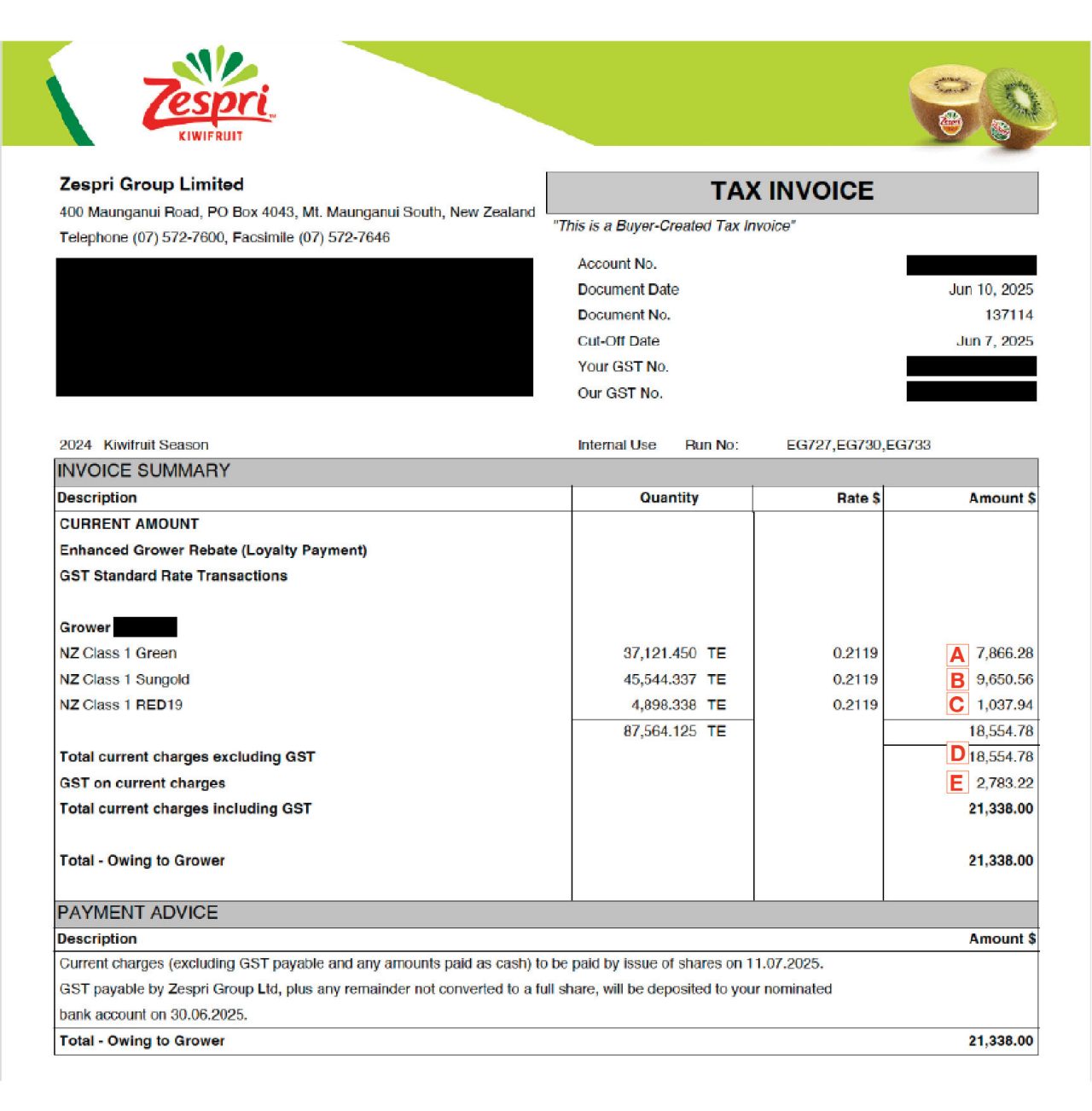
You should have received an invoice from Zespri (Zespri Generated Invoice). This document is created on your behalf so Zespri can process your Loyalty payment. This was supplied at an entity level and has a breakdown of your KPINs and payment by purchase pool type and takes into account if you have participated in LaS or not.
Even though this is an invoice, you don’t need to pay anything (we are paying you). You will need to keep these as a record to pass on to your accountant.
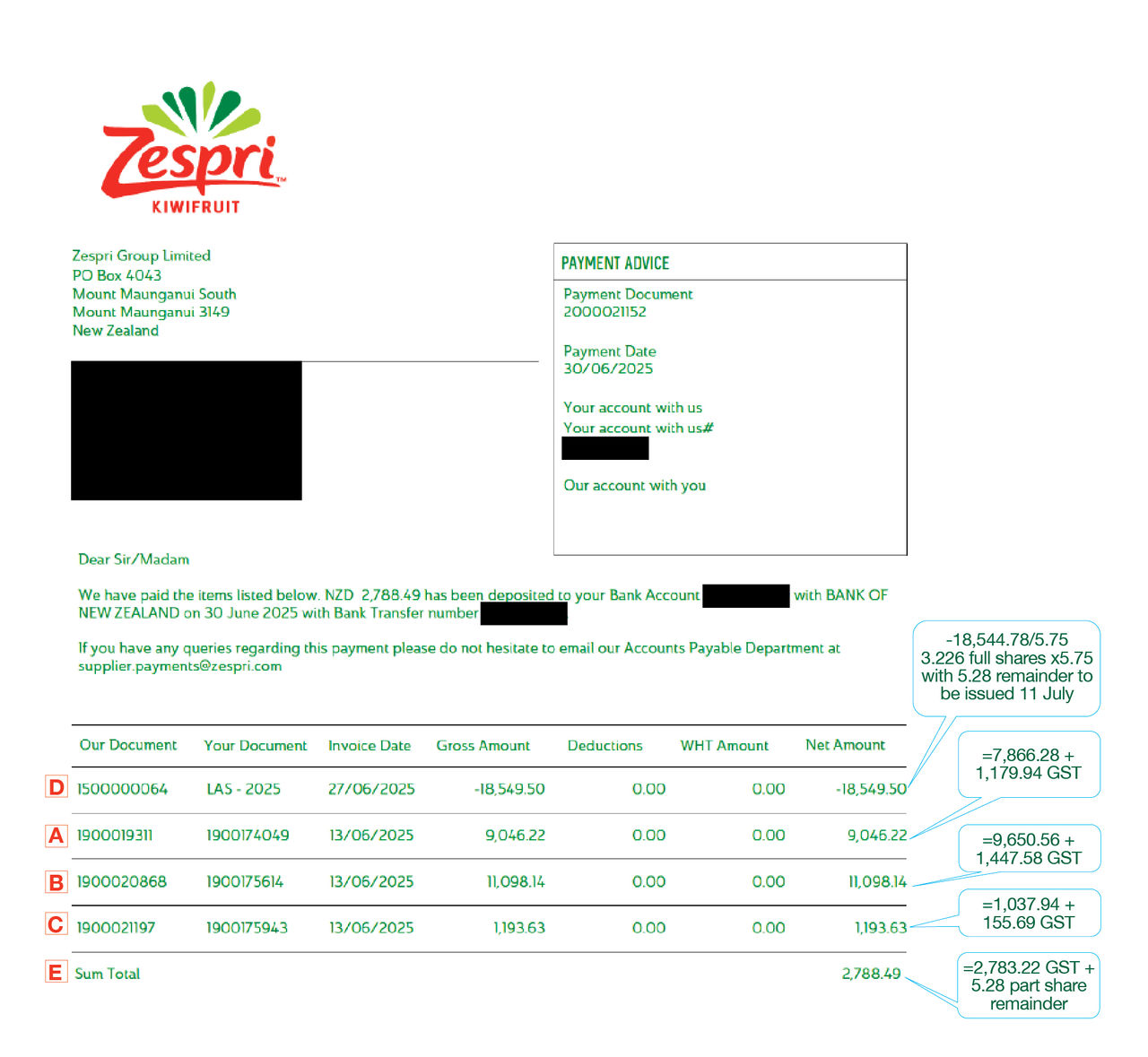
You should have also received a payment advice. This was created when the payment was made and will show what Zespri paid you, and into which account. If you opted in to LaS then the payment shows what amount of money was used to convert into Shares and the remainder paid is the GST and rounding for any part share.
Below are examples of the two documents which will help understand what was issued and what was paid as well as any information you will need to pass onto your accountant.
Alongside the two documents growers receive for their loyalty payment, growers can also go to the Industry Portal to view information for their loyalty payment in the reports section.
Selection of the ‘second loyalty payment’ filter will reflect the combination of the Zespri Generated Invoice and Loyalty Remittance Advice as above. This report provides details by pool and grower code for the loyalty payment which was made directly to your nominated account.
If you participated in LaS, you’re also able to see this converted to shares. Access to view these reports are available to an individual who is connected to the entity and who has the relevant permission and authorisation. If you are not able to view these reports ,and believe you should have access, please contact the Grower Support Services team to discuss requesting access.
Under the revised loyalty agreement, the loyalty premium will be calculated across Free on-Board Stowed (FOBS) trays, but paid across all trays submitted. This has the effect of spreading the premium and the fruit loss risk across all trays that make it into submit.
While the impact on average is very small, paying on submit trays has a greater proportional impact on growers who ship later and who have much higher fruit loss percentage than the season average. This revision does not change the total value of loyalty paid out and was agreed by the Industry Advisory Council in February 2024 for loyalty payments from January 2025.
Read more on the Loyalty Payments page.
All loyalty payments from 2025 will be made directly from Zespri to Growers’ nominated bank account, rather than being paid from your post-harvest entity.
We now require growers' bank account details, even if you do not intend on opting-in for the Loyalty as Shares initiatives for the second payment.
Key takeaways are:
Some growers have already supplied Zespri with their bank details. If you have, you will need to verify we have the right account details for your entity. If you haven’t had a direct payment from Zespri, we will need to collect your bank account and GST details to ensure we have time to pay your first loyalty rebate in January of each year. You will need to provide proof of your bank account details. Confirmation of bank accounts should include the account name and account number e.g. MJ Family trust. We will not accept the name being the “everyday account”.
Zespri will store your details securely in our system, in accordance with our privacy policy which you can view at zespri.com/en-NZ/privacypolicy.
Please refer to instructions linked below for how to update or verify your bank account details.
The Zespri Investor Relations team provides specialised support to the industry on everything shares related. If you have questions about shares or the share structure, please don't hesitate to ask. Email shares@zespri.com or call us on 07 572 6402.
Was this page helpful?