Zespri Climate Change Transition Plan
Zespri's ambition for a net zero, climate-resilient future.

Zespri has today launched updated sustainability targets as part of its 2035 strategy, supporting the kiwifruit marketer’s ambition to become the world’s healthiest fruit brand.
The targets were announced at the kiwifruit industry’s Momentum 2026 Conference in Mount Maunganui, attended by over 550 growers, shareholders, industry and post-harvest leaders, global supply-chain partners and customers.
Zespri Executive Officer – Sustainability, Carolyn Mortland says Zespri’s 2035 strategy depends on a healthy environment, with Zespri choosing to prioritise climate and packaging work as part of the company’s strategic focus on building brand-led demand, transforming global supply and creating the portfolio of the future.
“In developing our 2035 strategy, we’ve looked at how our approach to sustainability will help build the world’s healthiest fruit brand, including meeting our customers’ and consumers’ evolving expectations.
“We’ve got a strong platform to work from given the progress we’ve made towards the targets we set in 2020.
“While we didn’t reach all those targets, we delivered a climate strategy and adaptation plan, completed carbon-neutral orchard trials, biofuel trials and a green shipping corridor feasibility study, implemented fully-certified home compostable fruit labels and lifted our use of recycled material so that more than 90% of our Zespri branded transport packaging across all global markets is made from recyclable material.
“The updated targets we’ve set are about focusing our activity on the areas that we believe will help unlock a low-emissions climate-resilient future in what are more challenging conditions, and signal our long-term ambition for Zespri to reach net zero emissions by 2050.
“Achieving net zero requires sustained action across our industry and supply chain and we intend on doing this in stages over time, working collaboratively with our partners. This includes advocating for the infrastructure and system changes needed to enable low emissions solutions, and supporting the development and scaling of practical, economically viable options across our value chain,” says Ms Mortland.
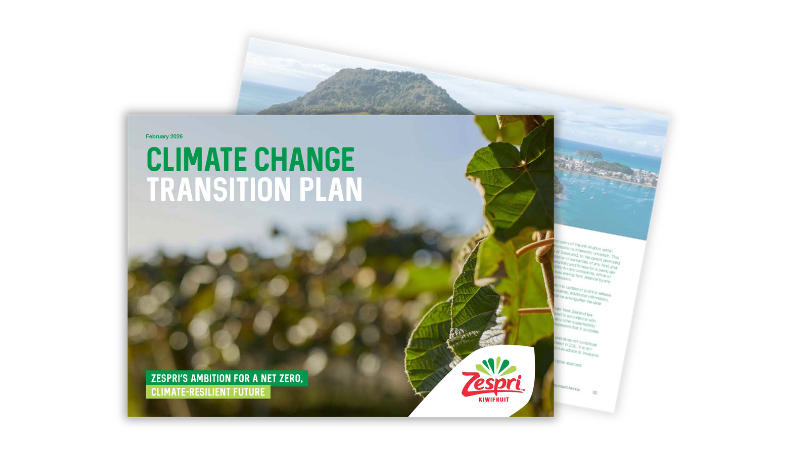
Zespri today also released its Climate Change Transition Plan, outlining the following three short-term climate targets:
Climate change is increasingly impacting orchards and supply chains, with more frequent and severe weather events occurring in New Zealand and globally.
“These are having a real impact on growers, infrastructure and logistics, and we’re seeing these events shape the rules of trade through new regulation and reporting requirements.
“That’s matched by rising customer expectations for suppliers to set rigorous climate targets, and consumers who want to buy from brands which support the environment. It’s critical we’re meeting that challenge.
“Our Climate Change Transition Plan highlights our focus on delivering climateresilient cultivars, better climate insights, and knowledge-sharing to help futureproof supply and support more resilient orchards.
Packaging also remains a major priority for Zespri, with two environmental packaging targets announced:
Ms Mortland confirmed there was a focus on looking at how Zespri reduces the environmental impact of our packaging which is critical to supporting the quality of kiwifruit all the way to customers and consumers around the world.
“We’ve made important progress, including the rollout of our world-first 100% home compostable fruit label, ensuring over 95% of Zespri branded packaging in Korea is now recyclable and there is more than 50% of recycled content within our US Zespri branded plastic consumer packs.
“These packaging targets reflect the practical realities we’ve seen in recent years, future regulation, and will support us in meeting customer and consumer expectations.”
“We are taking action on sustainability now so we can continue to deliver high-quality great-tasting Zespri Kiwifruit to our markets around the world, and maximise value for our growers and shareholders,” says Ms Mortland.
Zespri’s Climate Change Transition Plan can be found here.
The full scope of and assumptions for Zespri’s new climate targets can be found in Zespri’s Climate Change Transition Plan.
The scope of Zespri’s new packaging targets covers Zespri branded packaging across consumer packs and transport packs, as well as all Zespri-branded fruit labels, from postharvest operations, 3PLs through to Zespri direct customers.
Transport packaging includes all Zespri transport packaging products and components used for the containment, protection, handling, delivery, storage, transport and presentation of Zespri kiwifruit in all of Zespri’s markets worldwide (this includes plastic pallet strapping, but excludes shipping pallets, corner boards and interconnecting strips).
Consumer packaging includes all Zespri branded consumer-facing kiwifruit packaging products and components (including spifes) used by Zespri or its direct customers in Zespri’s primary markets, which are identified as: Australia, Belgium, Canada, China, France, Germany, Hong Kong, Italy, Japan, Netherlands, New Zealand, Singapore, South Korea, Spain, Taiwan, United Kingdom, and the United States.
Was this page helpful?